
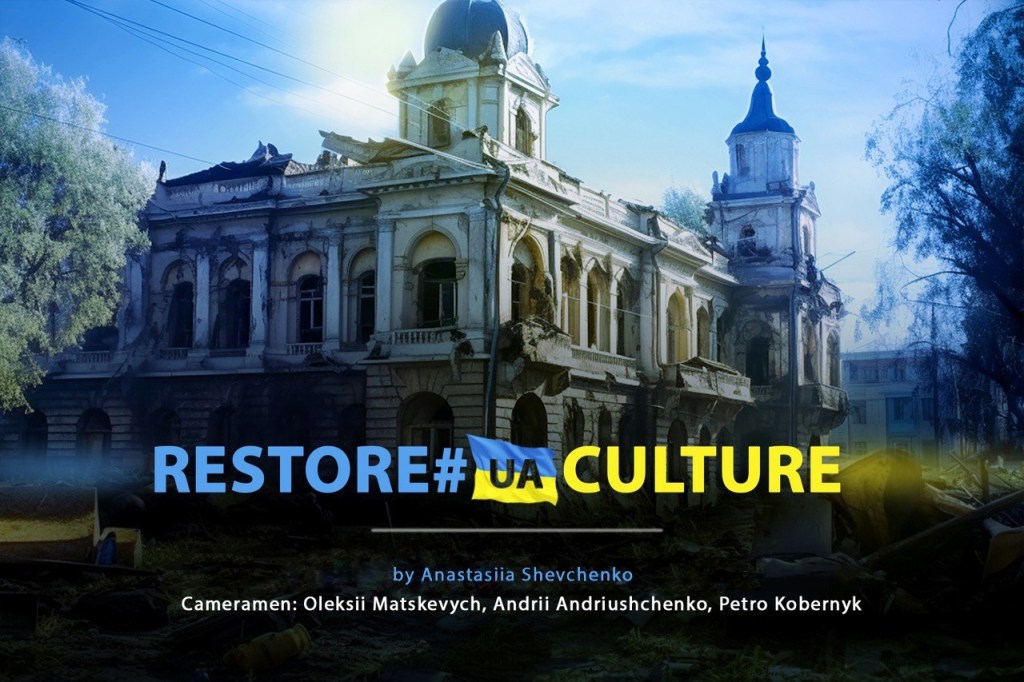
“Restore#UACulture”
is a journalistic project founded by Dr. Anastasiia Shevchenko
This project focuses on researching and highlighting the destruction of Ukraine’s cultural heritage caused by Russia’s full-scale military invasion. What stands out most is not merely the looting, which is a common occurrence during wars, but the deliberate and cynical destruction of cultural heritage. This includes both the reclamation of pre-modern objects to frame them as part of an extended Russian historical narrative – encompassing Greek and Sarmatian materials – and the systematic erasure of Ukraine’s modernist cultural tradition. While this modernist tradition engaged in dialogue with Russian culture, it was distinctly separate from it. In many ways, this destruction completes the erasure initiated during Stalinist times.
Russia continues the autocratic imperial tradition then the totalitarian Soviet legacy by attempting to obliterate authentic Ukrainian culture through the systematic destruction of all “prominent” elements – cultural institutions, artistic spaces, notable figures, and cultural memory itself. Russian ideologues is deliberately pursuing a policy of constructing a unified historical memory of Slavic peoples, centered around either the “Great Victory” in the so-called “Patriotic War” or nostalgia for imperial grandeur – an ideological contradiction in itself, as one regime directly opposed the other.
The aim of this project is to document interviews with cultural figures from southern Ukraine who have witnessed the occupation and crimes against Ukrainian culture, and to raise global awareness of Russia’s aggression toward Ukrainian cultural institutions and artists.
During the initial phase of the project, our efforts are focused on the Kherson region. In 2022, nearly the entire territory of this region fell under occupation by Russian forces.
From September 23 to 27, 2022, the occupying authorities in the Kherson region conducted a so-called “referendum” to illegally annex the territory to Russia.

Later that autumn, amid the successful counteroffensive by Ukrainian armed forces, Russian soldiers began systematically removing cultural artifacts from museums and libraries, transferring them to the left bank of the Dnipro River. Under the guise of “evacuation,” the occupying puppet government looted the region’s two largest museums – the Kherson Regional History Museum and the Kherson Art Museum.
Serhii Nemtsev, a specialist at the Department of Monitoring the Situation in Occupied Territories under the Ministry of Culture of Ukraine, described the condition of the Museum of Local History as devastating (interview recorded in July 2023). The museum’s entire exhibition was stolen. Although constant shelling makes a comprehensive assessment impossible, preliminary estimates suggest that more than 28,000 exhibits have been plundered.


But this is not the final number, because almost all the accounting documentation was stolen, and the preliminary review was made on the basis of thematic-exposition plans and those inventory books that were partially preserved.

No less tragic is the situation in the Kherson Art Museum, from which 90 % of the entire collection was stolen.
From an interview with Alina Dotsenko, director of the Kherson Regional Art Museum :
“And so they stole, stole the best works, more than 10 thousand. We had a little more than 14 thousand before the war. Steal better.
They stole the 17th, 18th, 19th, 20th and 21st centuries, all painting, all applied art such as gold and silver embroidery, almost all watercolour graphics were stolen. Of course, we had works by Shovkunenko, this is the largest collection, our museum bears his name. We had the works of Yablonska, Serebriakova, Hlushchenko Pymonenko, Aivazovsky, Vrubel. We had a wonderful work by the British portrait artist Peter Lely (ed. Pieter van der Faes), “Lady with a dog”. We had icons of Shibanov.There are many things that cannot be found in other museums, not only in Ukraine” They took out our collection a week before the Kherson liberation. A week before. But we were betrayed (ed.: place where the collection was hidden) a few months before by internal collaborators, traitors.
Everything was exported on a large scale. Everything was organized. Andrii Malgin, the director of the Tavrida Museum of Local History in Simferopol, and his deputy Shkedya, who is an FSB officer, came from Crimea with large tarpaulin vans”.
Тhe Kherson Regional Art Museum named after Oleksii Shovkunenko


In August 2-3 2023, the Russian military fired aimed fire at the largest Kherson regional library named after Oles Honchar.


“On the night of August 2-3 2023, the Russian military fired aimed fire at the library. I emphasize that the shots were aimed, because there were three hits. They knew where they were shooting. I emphasize that this is the second shelling of this library. 30-40 % of the southern side is completely destroyed”, – from the interview with Oksana Shestakova, head of the department of socio-cultural activities of the Kherson regional library named after Oles Honchar.
But the shelling continued. And on November 12, 2023, an attack actually destroyed the library building.
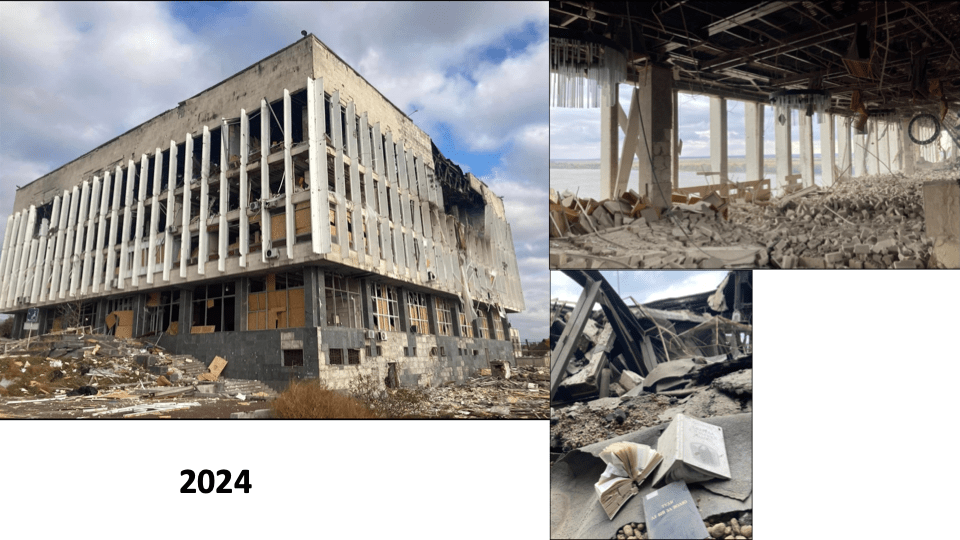
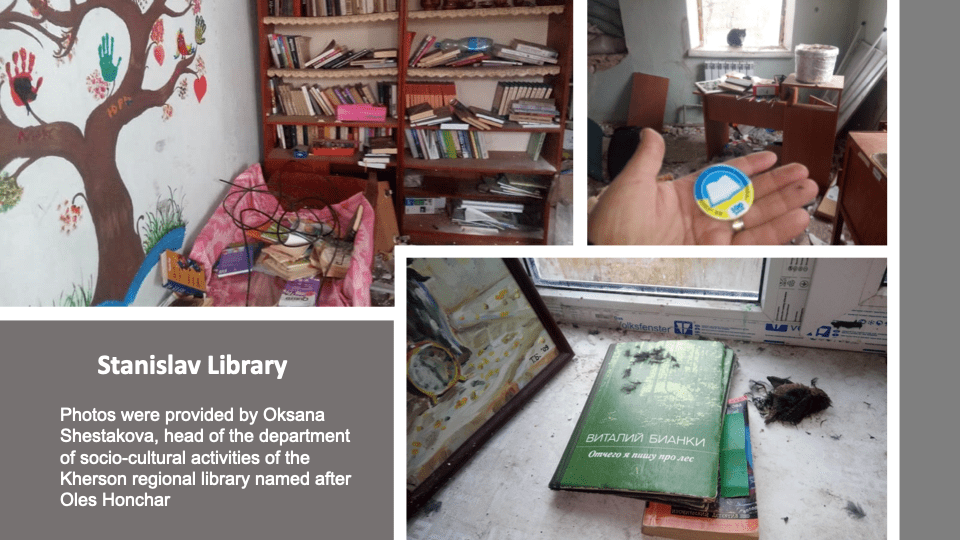
According to testimonies from librarians across the region, Russian soldiers frequently turned library halls into makeshift barracks, dismantling the cultural spaces around them. Olena Maliarenko, writer and director of the Stanislavska Public Library, revealed that her library building even housed a torture chamber.


On June 6, 2023, Russian forces committed a grave act of ecocide by destroying the Kakhovka Hydroelectric Power Plant (HPP). This catastrophic event led to widespread flooding, devastating numerous museums and libraries, many of which are beyond restoration. Among the irreplaceable losses was The House-Museum of the renowned Ukrainian artist Polina Raiko, a unique monument to Ukrainian applied art. Located in Oleshky – an area under Russian military control – it was entirely submerged.
During the occupation of the city, cultural figures became targets of arrests and repression, in particular, On March 23, 2022 the Russian FSB detained Oleksandr Knyha, Director of the Kherson Music and Drama Theatre.
 UA STUDIES IN SWITZERLAND